

Wilkes University Receives Over $1.2 Million in National Science Foundation Grant Awards
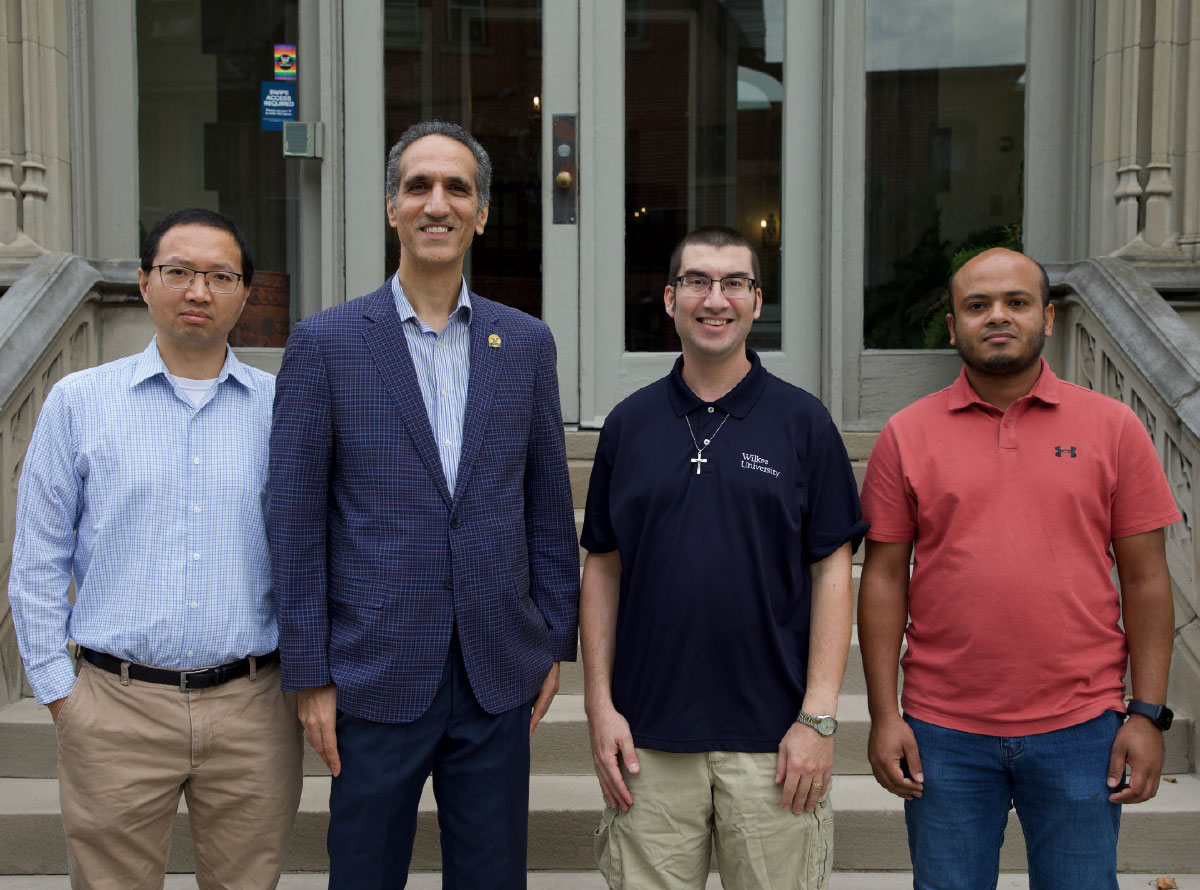
Though the grants are for two separate projects, both have collaboration at their heart. Whether it is working with area schools and industry professionals to provide hands-on learning to high school students or partnering with other universities, both grants emphasize the value of working together.
The two projects, titled “Experiential Learning for Artificial Intelligence-Driven Robotics in Northeast Pennsylvania (EXPLOR-NEPA)” and “Building Relationships in Innovation and Development for Growth in Emerging Technologies (BRIDGE-TECH),” both had Abas Sabouni, professor and chair of the Department of Mechanical and Electrical Engineering, as their principal investigator.
EXPLOR-NEPA focuses on bringing STEM education and experiential learning to high school students, preparing them for a future in technology, while BRIDGE-TECH brings together five regional universities, including Wilkes, to work toward creating a stronger, more robust ecosystem for innovation and workforce development through close coordination and collaboration.
NSF grant proposals are notoriously competitive, and this round was no different, with a funding rate of just 26% for over 40,000 total proposals submitted. To be successful, a proposal must align with national priorities as identified by NSF, but also have clear, worthwhile and demonstrable goals. That Wilkes’ two projects were among those selected speaks to the strength of those proposals, as well as the high value of their stated outcomes and the potential for positive impact on our community and the wider region.
EXPLOR-NEPA: Expanding Robotics and AI Education for Young Learners
EXPLOR-NEPA, which received more than $800,000 in funding from the NSF, is a direct response to this educational imperative. The program, categorized under the NSF’s Experiential Learning for Emerging and Novel Technologies (ExLENT) program, builds upon Wilkes’ already strong emphasis on experiential learning by partnering with local high schools to introduce hands-on experiences in robotics and artificial intelligence to high school students.
“As faculty, we regularly see students arrive at college with strong potential but little opportunity to explore fields such as artificial intelligence, robotics and automation before making critical academic and career decisions,” Sabouni says. “We intentionally designed EXPLOR-NEPA to respond to this gap by integrating hands-on experiential learning, dual enrollment and industry mentorship into a coherent pathway that begins in high school and extends into college.”
The project aims to serve 100 students over a three-year period, first by providing foundational robotics and AI education through robotics clubs, and then progressing to university-level courses through dual enrollment at Wilkes. Additionally, eligible students will have the opportunity to pursue paid summer internships through a partnership with Production Systems Automation in Duryea, Pennsylvania. Students will also partake in a scholar program that features job shadowing, mentorship and capstone projects. This variable approach provides students a bedrock of STEM experiences, which they can build on as they advance in their education and, ultimately, their careers.
The benefits of early exposure to STEM education are not limited to just future scientists and engineers. Studies have shown that programs such as EXPLOR-NEPA also greatly increase creative thinking, as well as students’ ability to solve complex problems unrelated to STEM. “For students, the ideal outcome is empowerment, both academically and professionally,” says Sabouni. “We want participants to gain technical skills and problem-solving ability, but equally important, we want students to see themselves as capable innovators, equipped with the confidence to pursue higher education and competitive career pathways.”
BRIDGE-TECH
BRIDGE-TECH is Wilkes’ answer to this call from the NSF for institutional collaboration. Receiving $400,000 through the EPIIC program, BRIDGE-TECH will see Wilkes partnering with Penn State Harrisburg, University of New Haven, Bradley University and Widener University. Working together, these schools will bolster research opportunities, enhance innovation culture and technology transfer, develop design thinking and innovation accelerators, drive innovation in rapid manufacturing and create synergistic opportunities for academic research.
This last point will be the focus of Wilkes’ contribution to BRIDGE-TECH, as it sets about establishing the Synergistic Opportunities for Academic Research (SOAR) center. This center will act as a centralized hub for managing and expanding partnerships with industry, government and community organizations.
“The SOAR Center will strengthen innovation capacity at Wilkes by creating a centralized database of faculty expertise, facilitating collaboration with regional and national partners and supporting faculty development in grant writing, technology transfer and entrepreneurship,” says Sabouni. “Over time, this project will help establish Wilkes University as a model for how primarily undergraduate institutions can cultivate sustainable innovation ecosystems.”
BRIDGE-TECH strengthens all universities involved by giving each access to the other’s resources, including faculty expertise, facilities and technology. Through these mutualistic efforts, each partner in BRIDGE-TECH will be able to expand their research opportunities and gain greater exposure for their findings, which in turn may lead to more funding opportunities from industry and governmental partners.
Now more than ever, it is vital for institutions of higher learning to remain creative, innovative and collaborative. Both EXPLOR-NEPA and BRIDGE-TECH are examples of how Wilkes is working with the community, as well as industry partners, to remain ahead of the curve and provide pivotal and transformational educational and research opportunities.