

Dr. Bing K. Wong College of Arts & Sciences Demonstrates Proof of Love for Wilkes

While his gift — the largest individual donation in University history — will have incredible impact, the words of former students and colleagues tell the true story of how Wong’s effect on lives and careers adds up to a phenomenal legacy.
Saunders was at Wilkes when Wong joined the college as professor and chair of the Department of Mathematics in 1968. Though enrolled in the teaching program, she couldn’t see herself at the front of a classroom. Wong didn’t see her there either. “No one was giving me the push to get out of the space I should get out of,” says Saunders. “But he gave me his attention. I feel like he nudged me. Or if he didn’t, he gave me the tools.”
Wong’s classes in topology captured her imagination and she went on to study the subject in depth during graduate school at Penn State. Her rewarding career in the tech world started in State College, Pennsylvania, followed by 15 years working in Palo Alto, California, in the heart of Silicon Valley. None of which would have been possible without Wong’s guidance.
As a professor, Wong’s focus extended beyond the textbook to the students’ skills — and their future paths.
Mary Rhodes MS ’77 met Wong as a graduate student. She arrived on campus with a passion for math. “I loved math since I was a child. It was either right or wrong. There’s no in between,” says Rhodes. She knew she wanted to be a teacher, but she wanted to pursue higher mathematics, not mathematics education.
Rhodes was the only graduate student in math at the time, and none of the professors were women. “That was standard in the 70s, but I was totally accepted. The faculty treated me as an equal,” says Rhodes. “I did not suffer from any gender discrimination at all.”
Recognizing her abilities, Wong petitioned for permission for Rhodes to take an overload of six classes in the fall and spring semesters to complete her graduate degree. She continued to teach, retiring in 2001 after 40 years in the classroom.
Still, Rhodes and her mentor didn’t always agree, at least in the moment. “He insisted that I take computer science classes, which I wasn’t too keen about,” she says. “But I’m awfully glad I did.”
At the time, the classes in Fortran and COBAL were new to Wilkes — Wong introduced computer science courses to the curriculum in 1976 — but they’ve become another enduring part of the professor’s legacy.
Nate Martes, a junior computer science major, is proof.
Born and raised in New York City, Martes moved to Wilkes-Barre with his family when he was eight years old. As a video game fan, Martes decided he didn’t just want to play games — he wanted to make them. While in high school, Martes started looking into colleges. He knew he didn’t want to go too far from home, and he found the professors at Wilkes to be the most welcoming.
Not only have they been welcoming, but the computer science faculty have followed in Wong’s footsteps by pushing students to the next level.
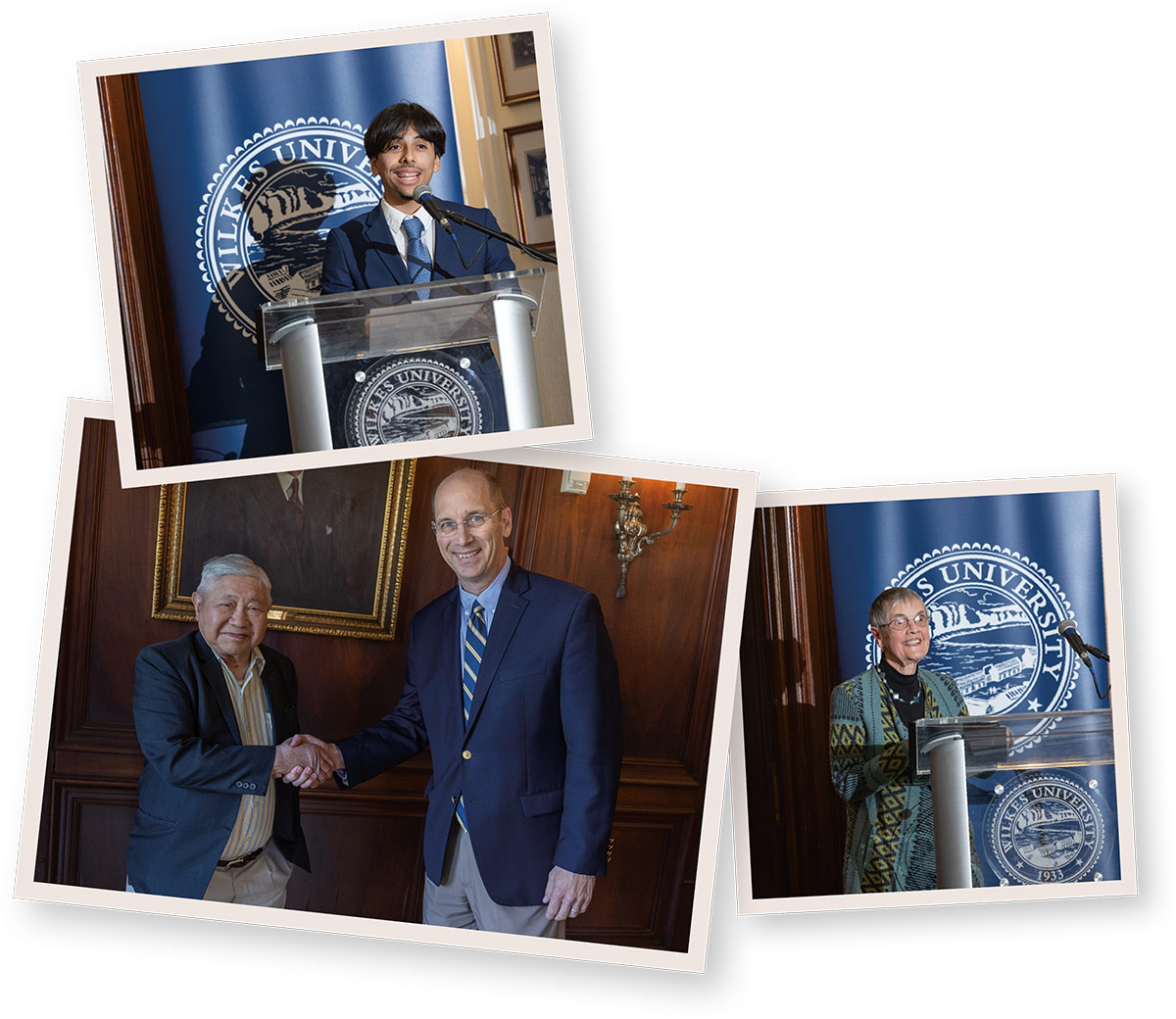
While Martes never had the opportunity to study under Wong, he’s grateful for the professor’s generosity and his vision. At the November dedication to honor Wong’s gift, Martes offered his thanks. “Because of your investment, we can proudly say that we are students of the Dr. Bing K. Wong College of Arts and Sciences, empowered, inspired and fully prepared to step confidently into our chosen professions.”
Though they didn’t share time in the classroom, perhaps Wong and Martes share a bit of the same tenacious spirit.
After graduation, Martes plans to pursue a career in software engineering for a few years before continuing his computer science education in grad school. He has no doubt that his time at Wilkes provided him with the skills to level up. “If you try hard enough, you will get where you want to go,” says Martes.
Stephen Tillman, professor emeritus of mathematics, was hired by Wong in 1970 and spent his entire 42-year career at Wilkes. He recalls Wong’s persistence. “He was not reticent about stating his opinion. He was also very persistent. Therefore, he was usually able to wear down those who disagreed with him,” says Tillman. “This trait helped the department.”
Wong was known for his pursuit of what was best for the department and its students. He landed an equipment grant from IBM and put Sullivan in charge of setting up the PC lab. The dedicated space, along with a UNIX server, powered computer science at Wilkes and continues to shape the program.
“That server, of course we’ve gone through several generations since then, has been absolutely vital in the mentoring program that I’ve been dealing with for 31 years,” says Sullivan.
For all of the stories from those fortunate enough to work with and learn from Wong, he shows humility when discussing his life and career. In Hong Kong, he went to a high school famous for its math and science programs. “I did reasonably well,” Wong says.
From there, Wong pursued higher education in Taiwan, then earned a full-tuition scholarship to Northeastern Oklahoma A&M College. He stayed for a year before moving on to Kansas State College of Pittsburg, where he earned his bachelor’s degree.

Another memorable moment is more lighthearted. He was headed for Miami, Oklahoma, but some of his relatives in Hong Kong expected a much warmer Miami. “That was a big shock for me,” says Wong. “In fact, one of my uncles gave me a Hawaiian shirt.”
When Wong graduated with his doctorate from Illinois, he had his choice of institutions, but Eugene Farley, then president of Wilkes College, had made a commitment to local business leaders to develop a mathematics program at the college. Farley offered Wong, just two years out of school, a full professorship and chair of the Department of Mathematics.
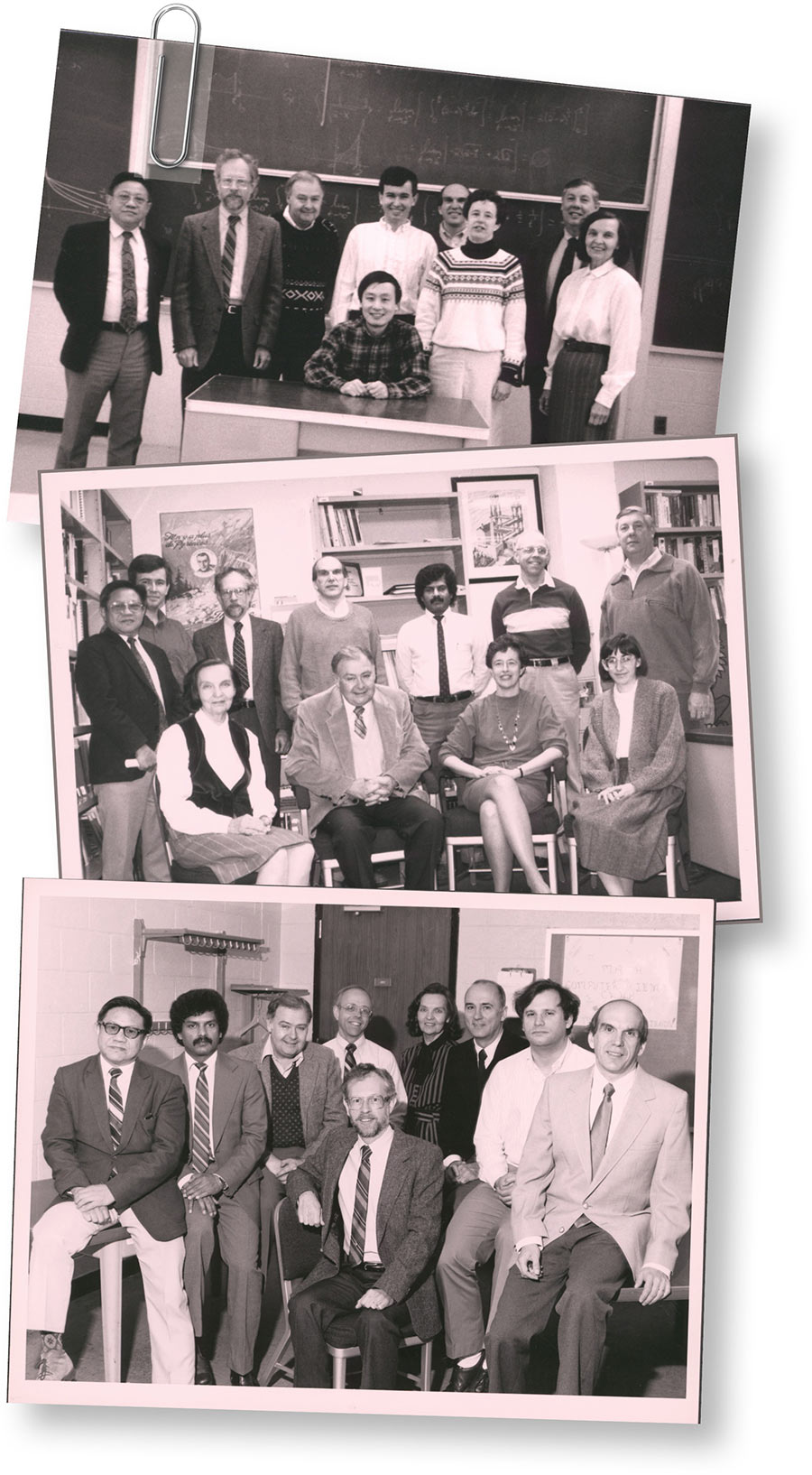
Building the math department was one of Wong’s many successes at Wilkes, along with his introduction of computer science classes and his proposal for the liberal arts curriculum, which survived a heated debate by the faculty for adoption — by one vote.
Though Wong never pictured a career in anything other than mathematics, he steadfastly believes that the liberal arts are a vital component of higher education. “Technical fields give you the skills to make a living, but liberal education broadens your mind and makes you a better person,” says Wong.
Perhaps then it’s especially fitting that Wilkes University honors his legacy and generosity with the naming of the Dr. Bing K. Wong College of Arts and Sciences, though extravagant tributes aren’t his style.
“The point is, I was lucky in some ways,” Wong says. In 1984, Apple came out with a new computer called Macintosh, a tiny box with a black and white screen. Wong bought one and enjoyed using it, so he also scraped together the money to buy 200 shares of stock — at $13 a share. “Over the next 40 years, Apple became one of the most important corporations in the country.” And his shares of Apple grew.
Wong chose to use that growth to Wilkes University’s advantage. “My dad told me that life is about choices. I could probably afford to buy a pretty fancy house and some other things, but that’s not my lifestyle. My lifestyle never changed. We live a simple life. So I thought that it was good to leave a little legacy at Wilkes.”
While Wong’s lifestyle hasn’t changed, his gift will change the lives of Wilkes students, as his teaching and mentorship have for four decades. Still, he’s not looking for accolades. “I don’t want to be built up into a saint. I’m just a regular guy hoping my contribution can do some good at Wilkes.”