

A New World
Wilkes School of Education helps schools navigate digital learning
“We are going to see if you are smarter than a fourth grader,” says Jessica Cordaro MS ’20, faculty of practice in the School of Education. Cordaro is using Blooket, a free app offering educational games, to engage the future teachers. “I’m using questions similar to what is on the science PSSAs,” she adds, referencing the standardized tests used by the state of Pennsylvania to assess student performance against state standards.
On a colorful screen, animal avatars identify student teams as they answer science questions using phones, laptops and tablets.
“Which animal lives in water when very young and lives on land as an adult?”
Music with an energetic drumbeat plays while students respond. The correct answer is announced with a drumroll and a gong: A frog!
The use of technology in Cordaro’s class reflects a fundamental truth about teaching and learning in today’s digital world. Digital tools — like interactive apps, videos and gamified learning — can engage students, capturing their attention more effectively than traditional methods. Digital literacy is an essential 21st century skill. Familiarity with technology prepares students for future academic and career environments.
Wilkes doctor of education alumnus Dan Magie EdD ’24 supervises technology for Unified School District 327 in rural Kansas. “Without technology, we can’t participate as a full citizen in our current system,” Magie says, noting technology is used to file taxes and access government services. “There’s not much employment that won’t involve some sort of technology.”
The need is further reflected in the Pennsylvania Department of Education’s new integrated standards for Science, Technology & Engineering, and Environmental Literacy and Sustainability (STEELS). STEELS establishes a consistent approach to science education for students in grades K-12. Cordaro says, “Because our new science standards for Pennsylvania have a whole branch on technology and engineering, I want the students to be comfortable with both incorporating technology into their lessons and teaching about technology.” The standards outline expectations for understanding and using technology in a variety of contexts from kindergarten through high school.
Ensuring educators can implement such standards is a priority in all Wilkes education degree programs, from bachelor’s through doctorate. “If we’re not teaching our students how to navigate that new world, then we’re not preparing them for what is waiting for them out there,” says Charlie Smargiassi MS ’07, department chair of undergraduate education and assistant professor, education and leadership development.
Wilkes’ bachelor’s degree programs familiarize students with digital tools for the classroom. Students earning advanced degrees, such as the master’s degrees offered in online teaching, instructional media and instructional technology, take a more specialized approach. Because most people enrolling in those programs are teachers or school administrators, schools directly benefit from lessons learned.
Graduates of the master’s degree program in instructional technology assume leadership roles developing policy, coaching other teachers or leading district-wide technology policy and training. Participants can earn Pennsylvania Department of Education certification as an instructional specialist. The program also appeals to students who have an interest in becoming curriculum designers or corporate trainers. A planned expansion of program offerings in fall 2026 will include a corporate training track.
Because the master’s degree programs are virtual, they offer opportunities for professional development for school districts anywhere. Since 2018, the Methacton School District in Montgomery County, Pennsylvania, has had three cohorts totaling more than 30 teachers complete the STEM letter of endorsement program. Tara Ricci, Methacton’s supervisor of continuous improvement, says participation, “shifted (teachers’) thinking about instruction to a more hands-on and collaborative practice in the classroom.”
The University’s doctorate of education (EdD) curriculum approaches technology from a different perspective, examining technology issues through the lens of the program’s focus on leadership.
Karim Medico, associate professor and chair of the doctoral program, says, “What we talk about is, how do we guide K-12 institutions and students to integrate technology safely, intentionally and purposefully towards the fulfillment of learning objectives and the fulfillment of their well-being and their personal development in a digital world?” She notes the doctorate is designed so that students can apply program content to their individual school environments.
Choosing Technology to Engage Students
“It’s a teaching strategy,” Smargiassi says. “You have to be willing to expand your tool set. You have to be thinking not only, how can I improve myself, but how can I engage the students? Engagement is the issue with the current generation … It’s up to us to figure out how to make that happen.”
Pre-service teachers working toward bachelor’s degrees are required to take a common class about technology in education. In addition, best practices about implementing technology are embedded in all undergraduate education courses. “You can’t show students everything they need to know in one three-credit course,” Smargiassi says. “If you were to come to our classrooms, you would see we’re always incorporating new technologies into our own instruction so that we can show students what it looks like to utilize what’s available to them.”

Dr. Richard Abbas Alley Gives $2 Million to School of Education
Wilkes University received a $2 million gift to support its School of Education. The gift, given by local physician and philanthropist Dr. Richard Abbas Alley, will be used to support the University’s mission of providing transformative educational experiences for undergraduate and graduate students in the study of education.
The School of Education will be renamed the Dr. Richard Abbas Alley School of Education at a dedication ceremony this summer.
“Wilkes University is incredibly grateful to Dr. Alley for his generosity and support of our School of Education, which will now bear his name,” says University President Greg Cant. “This investment in the future of education is a testament to not only Dr. Alley’s passion for learning and investment in our community, but also a furthering of our goal to nurture well-prepared and successful lifelong learners.”
Dr. Alley built a career in medicine, providing exceptional care to patients in northeastern Pennsylvania for decades.
“It is my hope that this gift will provide students of today with the tools and skills needed to become the classroom leaders of tomorrow,” says Dr. Alley, noting that this gift would not have been possible without the thirst for knowledge, care, connection and experiences made possible by his parents, Abbas and Maliha Alley. The couple followed their dreams of a better life to Berwick, Pennsylvania, where they inspired their children through a tireless work ethic and belief in education. Dr. Richard Alley and his siblings — Ali, Amin, Samie, Elaine and Albert — all built successful careers and became pillars of their communities.
The College of Health and Education’s Dean Deborah Zbegner said the gift provides opportunities for resources that enhance teaching and learning strategies across all programs. “Our faculty and staff are grateful for Dr. Alley’s support of future educators,” says Zbegner. “Dr. Alley’s investment in the School of Education ensures our future as we address the teacher shortage by creating qualified educators who can enter the workforce through a variety of innovative pathways.”
Danielle Bartholomew MS ’24, an instructional technology graduate and a STEM/technology instructional coach in Pennsylvania’s Palmyra School District, says she learned ways to use technology to offer accommodations for students with special needs. “We had a really amazing class on accessibility for students,” she says, citing the example of a student in her district who is selectively mute and uses his iPad to read his work aloud.
Choosing digital tools that encourage active engagement is a priority, Cordaro says.
“If I ask students to incorporate technology in a lesson and they say they’re going to have their students watch a YouTube video, I give them feedback: Why don’t we try to get some deeper levels here to make it more meaningful and get the students more engaged?” Cordaro says. “I don’t want them to be passive with technology. We should be using it to do something that we normally wouldn’t be able to do.”
For example, instead of passively watching a video, students can use a site called Skype A Scientist, which allows teachers to arrange for a class to have a live discussion with a scientist in a particular field. Another example has students engaging in real-time collaboration on a Google document.
The advent of artificial intelligence (AI) as a tool is posing new challenges for educators on all levels. “It’s a rapidly emerging piece of our world,” Medico says. Graduates of master’s and doctoral programs are involved in developing policies for its use in schools. For example, Bartholomew will be tasked with implementing her school district’s policies developed in cooperation with an AI consortium of schools in the Lancaster-Lebanon (PA) Intermediate Unit 13.
Cybersecurity and Student Safety Online
“We have an entire track focusing on educational climate and safety,” Medico explains. “We talk about what kinds of safety we look to provide for students. We talk about health and well-being, social and emotional safety … As a leader, there are all kinds of lenses that you use to look at the health and well-being of your students and certainly digital is one of them.”
A cybersecurity class taught by Jane Blanken Webb, an associate professor in the doctor of education program, examines what it means to have a security mindset. “Most schools have strong security protocols in place for physical buildings, but there is a wide disparity when it comes to computer networks,” she says. Students in her class conduct an organizational cybersecurity assessment — a checklist of policies and practices developed by cybersecurity professionals — and review it with individuals responsible for computer systems in their schools. “It puts the leaders in the position to have the conversation with the people who know the answers,” Blanken Webb says.
Danielle Bartholomew MS ’24: Coaching Teachers to Be Tech Savvy


Danielle Bartholomew MS ’24 remembers days in her fifth-grade classroom during the pandemic.
“I’d be walking around with both my hands holding devices,” Bartholomew recalls. “I’d have my laptop in one hand, my iPad in the other, and I’d be walking around the classroom doing science lessons with kids in person and online.”
Bartholomew loved the challenge. It revealed a new direction for her career in Pennsylvania’s Palmyra School District. After six years in the classroom, she now is one of two district STEM/technology instructional coaches, supporting teachers and students. In her role, she travels to the district’s four elementary schools.
She trains teachers on new technology and works one-on-one with them, coaching them on implementing technology strategies in their classrooms. She also does “push-in lessons” with students, visiting every kindergarten, first and second grade classroom at least once a trimester — sometimes accompanied by a robot named Sphero Indi — to do STEM lessons.
As the district emerged from COVID, she approached Palmyra’s IT director, expressing interest in a technology support position. “I told her that people lean on me for tech advice,” she says. “I said if there was an opening, I was interested, but I also want to be qualified. I asked her what program she would suggest and she suggested the Wilkes program in instructional technology.” The master’s degree program prepares graduates to lead as instructional technology specialists.
Bartholomew extols the benefits of the Wilkes program. It expanded her knowledge base about things like how networking works.
“(The program) also gave me the foundation that I needed to justify the need for proper training with staff and students in rolling out new programs,” she says, noting one case where the knowledge gained at Wilkes allowed her to convince administrators she needed three days, not one, to properly train teachers.
“I feel like all day, every day, I’m thanking Wilkes for helping me get to the point where I am confidently doing my job,” Bartholomew says.
Students completing their internship in instructional technology also meet with district directors of technology to review cybersecurity. Treese notes, “One director of technology said, ‘I’m so glad the student had this assignment because we have now learned a lot about our cybersecurity … We didn’t even think of some things.’”
Students in master’s and doctoral classes also study ways to ensure the health and safety of students as it relates to the internet and social media. For example, a unit in one doctoral course called Children Living in a Digital World examines technology’s impact.
Blanken Webb notes that some of the things children and teens encounter online — from cyberbullying to pornography — pose a different kind of threat. Preparing parents to be partners in keeping students safe online is part of an educator’s role. “We need to have these conversations as educational leaders,” she says. To that end, some of her Wilkes doctoral students have developed projects to inform parents and the school community about online dangers. Projects have included parents’ night presentations, a series of informational newsletters and more. Because doctoral students are professionals working in the field, they can put these projects to practical use in their school districts.
As a school instructional technology professional, Bartholomew says she is involved in revamping her district’s digital citizenship curriculum, which includes guidelines for safe iPad use for kindergarten through second grade and also addresses issues such as technology addiction.
Rosalinda Sosa ’24: Taking Wilkes Lessons Into Her Classroom


Rosalinda Sosa ’24 came to Wilkes to study electrical engineering. But after spending the summer after her freshman year working with students in the University’s Upward Bound program, she fell in love with teaching and changed majors. She became the School of Education’s outstanding graduate in middle-level education in 2024.
Now Sosa is sharing her love of science as a first-year teacher in the Learning Academy at G.A.R. Memorial Middle School in Wilkes-Barre. It’s a homecoming of sorts for Sosa, who attended the STEM Academy in the Wilkes-Barre Area School District before enrolling at Wilkes.
She loves the academy model, in which she is paired with two partner teachers who teach math, science and STEM in a self-contained classroom. Sosa receives instructional coaching as a first-year teacher on the team.
She says Wilkes prepared her well for teaching, citing two classes as being especially helpful. One, a class exploring issues of inclusion and diversity with Diane Polachek ’78, MS ’81, professor of undergraduate education, has helped her to work more effectively with a diverse student population.
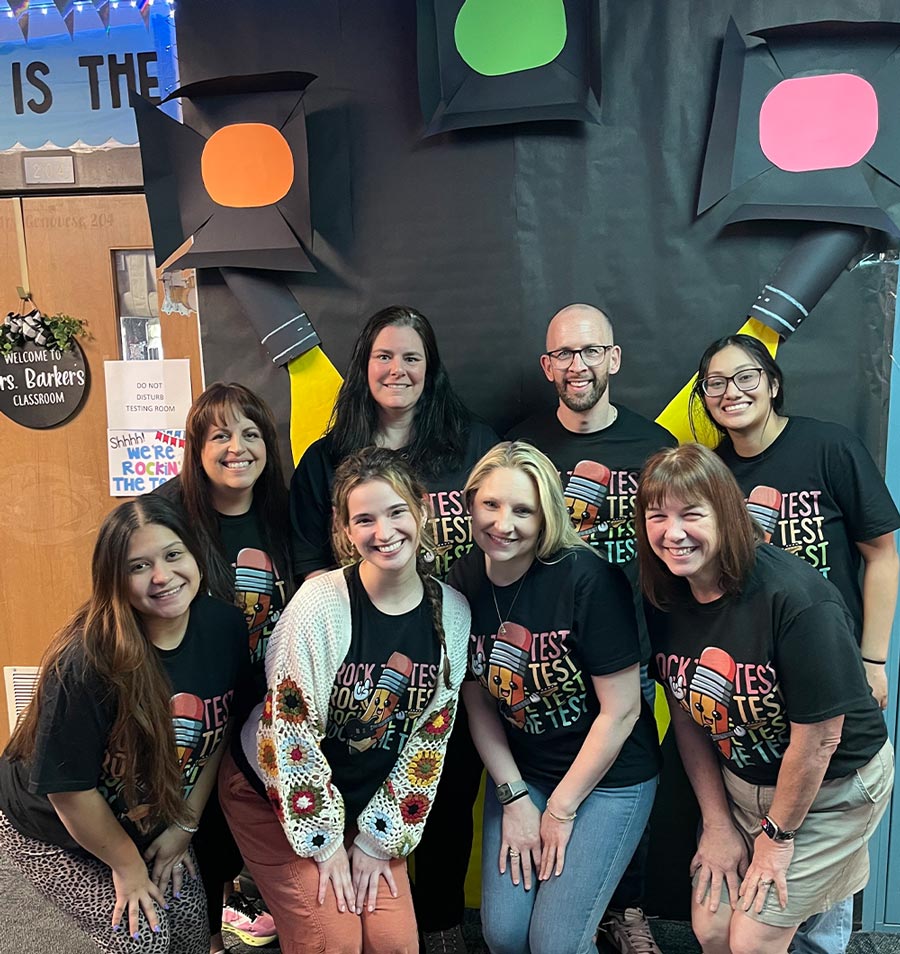
The technology lessons embedded in her Wilkes education classes have found their way into her lesson plans. “I try to maintain a balance of using the technology, as well as trying to incorporate some of the basic skills such as writing and translating things on paper,” Sosa says. Her students are doing a project designing food trucks. They are using Google slides for designing the trucks and Canva to design logos and menus. “Then they are incorporating those things into an actual, physical model,” she says.
She hasn’t completely left behind the lessons she learned in her Wilkes engineering classes. “I had them design something on paper and then had them build it with Legos,” Sosa says. “That’s something I did my freshman year and now I’m having my sixth graders do it as a STEM activity.”
Dan Magie EdD ’24: Transforming Technology In A Rural School District
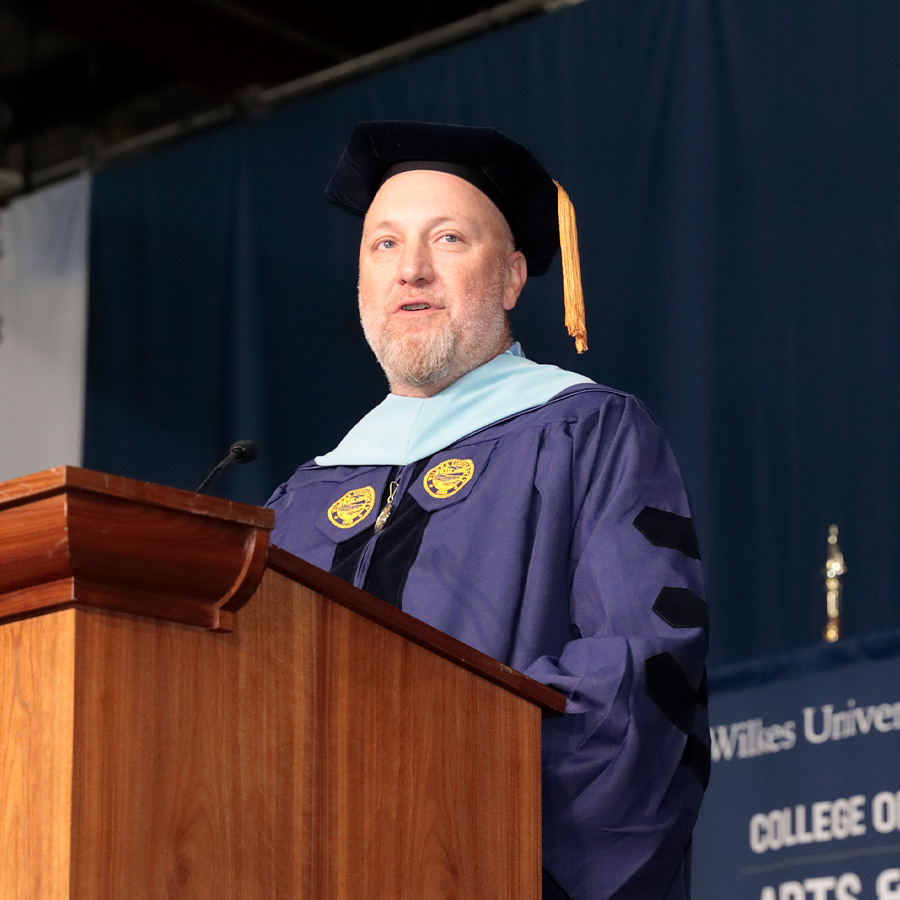

Dan Magie EdD ’24 says he used the leadership lessons he learned in the Wilkes doctor of education program to help transform the school district’s technology. As director of curriculum and instruction, he is responsible for all computers, software and networks, as well as budgeting to upgrade and maintain them.
Although he chose to earn his superintendent’s letter at Wilkes, he didn’t enter the program with a specific career goal. “I allowed the program to transform me,” he says. As he earned his doctorate, his responsibilities with his school district were evolving.
Magie, a Kansas native, had returned to the state in 2017, after teaching for more than a decade in Thailand, which had top-of-the-line technology. “I felt like I had stepped into a time warp when I came to rural Kansas,” recalls Magie, who at the time was teaching sixth-grade language arts. “I went to the school board and advocated for our first Chromebooks.”
After Magie entered Wilkes in spring 2020, he approached his superintendent seeking more responsibility. For over a year the district had been searching to replace the retiring technology coordinator, so Magie took over that position, along with curriculum and assessment responsibilities across the district. A third-party manager ran the district’s network, but Magie soon found himself responsible for many aspects of the computer system.
Although he took some technology classes at Wilkes, the leadership lessons he absorbed had the most impact. “I was able to acquire knowledge because of the concepts I was learning through the Wilkes program: building a professional network, using your resources, asking for help and to develop systems, so I’m not constantly redoing things,” Magie says.
The Elementary and Secondary School Emergency Relief (ESSER) funding available to school districts during COVID enabled him to purchase more Chromebooks for students, bringing the entire district to 1-to-1 access. He’s since developed a plan for replacements. “I’ve implemented a five-year cycle for replacement,” Magie explains. “Again, this is systems thinking. We replace 20% of our inventory annually. We’ve created a budget for that.” ESSER funding also enabled him to install smart screens in most district classrooms.
Developing that kind of system was one of the takeaways from his doctoral classes. “The best form of leadership is systems that stay in place when you leave. They outlive any one person,” Magie says.
Becoming Better Digital Citizens
“Something that I stress is that it’s really our job to teach students how to use technology appropriately and how to use it to their benefit,” says Treese. “That’s our responsibility as educators. One of the things we focus on in our instructional technology program is, ‘How do we teach responsible digital citizenship?’” Responsible use includes being respectful to others online, not spreading misinformation and respecting privacy.
Another way that Wilkes education students learn to incorporate digital citizenship into their teaching is related to the new Pennsylvania standards for science and technology. Some of the requirements address responsible use of technology, making it imperative that undergraduates preparing to be teachers incorporate it in their classrooms. Cordaro points to a standard for grades nine to 12 that asks students to “draw connections between technology and the human experience.”
“There’s another aspect to becoming good digital citizens that can’t be ignored,” says Magie. “I think it’s going to be important to teach each other about being human…That’s the next phase of technology education. We’ve got the access and we’re going to learn how to use these things. What we’re not going to learn (from technology) is how to continue to be human.”